Canon’s Vixia HF R800 offers a user-friendly experience, detailed in readily available PDF manuals and quick guides from sources like the Internet Archive.
These resources, including eBay listings and Northwestern University guides, provide comprehensive instruction for optimal performance and troubleshooting.
Unlock the camcorder’s full potential with downloadable guides covering all settings and offering assistance for a seamless recording journey.
Overview of the Camcorder
The Canon Vixia HF R800 is a Full HD CMOS camcorder designed for simplicity and portability. Manuals, easily accessible online via the Internet Archive and other sources, detail its core features.
It records directly to SD memory cards in MP4 format at 1080/60p, offering convenient storage and playback options. The camcorder boasts a 3.28 Megapixel image sensor and a DIGIC DV 4 image processor.
These guides cover everything from initial setup to advanced recording techniques, ensuring users can maximize the camcorder’s capabilities. Freshly printed PDF versions are also available.
Key Features and Specifications
The Canon Vixia HF R800’s key features, detailed in its manual, include a 3.28MP Full HD CMOS sensor and DIGIC DV 4 processor. It records in MP4 1080/60p, utilizing SD card storage.
PDF guides highlight Intelligent IS (Image Stabilization) for steady footage and a digital zoom function. The lightweight, portable body enhances usability. Specifications cover all programming settings.
Available resources from the Internet Archive and eBay listings provide a comprehensive overview, ensuring users understand the camcorder’s full potential and optimal performance.

Getting Started
Manuals and quick guides detail initial setup, battery charging, and SD card formatting for the Canon Vixia HF R800, ensuring a smooth start.
These resources, found online, provide step-by-step instructions for immediate use and optimal performance.
Unboxing and Initial Setup
Upon receiving your Canon Vixia HF R800, carefully unpack all components, referencing the included quick guide or the comprehensive PDF manual available online.
Verify the kit includes the camcorder, battery, power adapter, and necessary cables. The manual details connecting the power adapter for initial charging and outlines the process of inserting a compatible SD card.
Ensure the SD card is properly seated before powering on the device. The manual also guides you through the initial on-screen setup, including language selection and date/time configuration, preparing the camcorder for recording.
Charging the Battery
Refer to your Canon Vixia HF R800’s manual for detailed battery charging instructions. Connect the provided AC power adapter to the camcorder and a wall outlet, ensuring a secure connection.
The manual indicates a charging indicator light will illuminate, typically red while charging and changing to green when fully charged. Initial charging may take several hours; avoid interrupting this process.
The PDF guide emphasizes using only the supplied Canon adapter to prevent damage. Proper battery care, as detailed in the manual, maximizes lifespan and performance.
Inserting and Formatting the SD Card
The Canon Vixia HF R800 utilizes SD cards for recording and storage; consult the manual for compatible types and maximum capacities. Locate the SD card slot, typically on the side of the camcorder, and gently insert the card until it clicks.
The manual strongly recommends formatting the SD card within the camcorder’s menu system before first use. This ensures optimal compatibility and performance.
Formatting erases all data, so back up any existing files beforehand. The PDF guide details the formatting process, accessible through the camcorder’s settings.
Understanding the Camera Controls
Canon’s Vixia HF R800 manual details the function of each control, from the power button and mode dial to zoom and menu navigation.
Mastering these controls, as outlined in the PDF guide, unlocks the camcorder’s full recording capabilities.
Power Button and Mode Dial
The Canon Vixia HF R800’s manual clearly explains the power button’s function – a single press activates the camcorder, while a prolonged press initiates shutdown.
The mode dial is central to operation, offering selections like Video, Photo, Playback, and Setup. Understanding each mode, detailed in the PDF guide, is crucial.
Rotating the dial allows swift switching between recording, reviewing footage, and adjusting settings. The manual emphasizes proper dial usage for efficient workflow.
Incorrect dial positioning can lead to unintended operations, so referencing the guide ensures optimal control and prevents accidental settings changes.
Zoom Control and Focus
The Canon Vixia HF R800 manual details the zoom lever’s operation – gently push for wide-angle, pull for telephoto. Digital zoom is also available, though quality decreases with magnification.
Focus is primarily automatic, but the manual explains how to temporarily disable autofocus for manual adjustments, useful in challenging lighting conditions.
Precise focusing is achieved by observing the LCD screen and making subtle adjustments. The guide highlights the importance of sharp focus for professional-looking footage.
Understanding both zoom and focus controls, as outlined in the PDF, is vital for capturing clear, well-composed videos with the Vixia HF R800.
Menu Navigation and Settings
The Canon Vixia HF R800 manual thoroughly explains the menu system, divided into Setup, Recording, and Playback sections. Navigation utilizes the directional buttons and the SET button for confirmation.
Within Setup, users can adjust date/time, display brightness, and audio levels. The Recording menu controls video quality, recording modes (MP4), and image stabilization.
Playback settings manage viewing options and file deletion. PDF guides detail each option, allowing customization for optimal user experience and video output.
Mastering menu navigation, as described in the manual, unlocks the camcorder’s full potential.
Recording Basics
The Canon Vixia HF R800 manual details selecting MP4 recording modes and adjusting video quality settings for optimal results.
Start and stop recording using the designated buttons, ensuring proper SD card insertion as outlined in the guide.
Selecting Recording Modes (MP4, etc.)
The Canon Vixia HF R800 manual clearly explains the available recording modes, with MP4 being a prominent option for its compatibility and ease of transfer.
Users can choose from various resolutions and frame rates within the MP4 setting, impacting file size and video quality.
The guide details how to access these options through the camcorder’s menu system, allowing customization based on recording needs.
Understanding these choices, as outlined in the manual, is crucial for achieving desired results and managing storage space effectively.
Different modes cater to diverse scenarios, from standard definition to full HD recording.
Adjusting Video Quality Settings
The Canon Vixia HF R800 manual provides detailed instructions on fine-tuning video quality, impacting clarity and file size.
Settings like bit rate and resolution are key; higher values yield superior quality but demand more storage space, as the guides explain.
Users can access these adjustments via the menu, tailoring the output to specific needs – web uploads versus archival footage.
The manual emphasizes understanding the trade-offs between quality and storage, enabling informed decisions.
Optimizing these settings ensures the best possible visual results from the camcorder.
Starting and Stopping Recording
The Canon Vixia HF R800 manual clearly outlines the simple process of initiating and ceasing recordings.
Pressing the dedicated “Start/Stop” button on the camcorder body immediately begins capturing footage, as detailed in available guides.
A red recording indicator on the LCD screen confirms active recording, providing visual feedback to the user.
Pressing the same button again halts the recording, and the file is automatically saved to the SD card.
The manual stresses the importance of allowing the saving process to complete before removing the card;
Advanced Recording Features
Canon’s Vixia HF R800 manual details features like digital zoom and Intelligent IS for stable footage.
Users can also adjust exposure and white balance for optimal image quality, as explained in the guides.
Using the Digital Zoom
The Canon Vixia HF R800 manual explains how to utilize the digital zoom function for closer shots without physically moving the camcorder.
While convenient, the manual likely cautions that excessive digital zoom can reduce image quality, introducing pixelation and softness.
It details how to activate and control the zoom level, potentially through dedicated buttons or menu settings.
The guide emphasizes balancing zoom magnification with maintaining acceptable video clarity for the best possible recording results.
Understanding these limitations, as outlined in the manual, is crucial for effective use.
Utilizing the Intelligent IS (Image Stabilization)
The Canon Vixia HF R800 manual details the Intelligent IS feature, designed to minimize camera shake and produce stable footage, even handheld.
It likely explains different IS modes optimized for various shooting scenarios – panning, zooming, or general handheld recording.
The manual clarifies how to activate and adjust IS settings through the camcorder’s menu system.
Understanding the specific modes and their applications, as described in the guide, is key to achieving smooth, professional-looking videos.
Proper IS utilization significantly enhances video quality, especially during movement.
Adjusting Exposure and White Balance
The Canon Vixia HF R800 manual provides detailed instructions on controlling exposure and white balance for optimal image quality.
It explains how to manually adjust exposure settings to brighten or darken the image, compensating for challenging lighting conditions.
The manual also covers white balance adjustments, ensuring accurate color reproduction by neutralizing color casts.
Users can learn to select preset white balance modes or customize settings for specific light sources.
Mastering these controls, as outlined in the guide, is crucial for achieving professional-looking video results.
Playback and Viewing Options
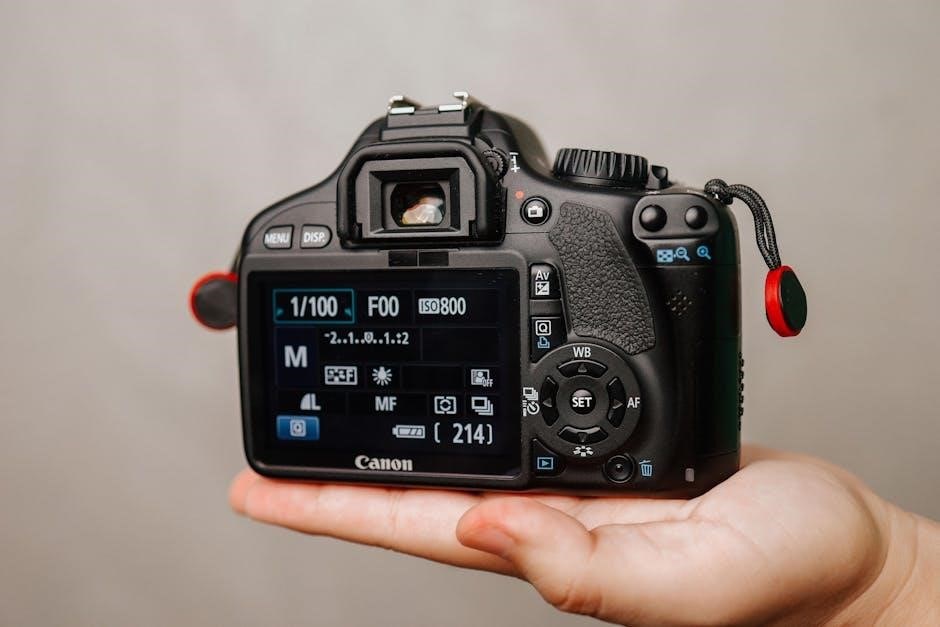
The Canon Vixia HF R800 manual details viewing footage on the LCD screen, connecting via HDMI to a TV, and transferring files to a computer.
It guides users through these playback processes for convenient enjoyment and sharing of recorded content.
Viewing Recorded Footage on the LCD Screen
The Canon Vixia HF R800 manual explains how to easily review captured videos directly on the camcorder’s LCD screen. Users can navigate through recorded clips using the playback controls, including play, pause, fast-forward, and rewind functions.
The manual details accessing the playback menu to select specific footage, delete unwanted clips, and adjust display settings like brightness and contrast for optimal viewing. It also covers utilizing the zoom function during playback to examine details within the recorded video.
Furthermore, the guide provides instructions on how to display essential information during playback, such as recording date, time, and remaining battery life.
Connecting to a TV via HDMI
The Canon Vixia HF R800 manual provides clear instructions for connecting the camcorder to a television using an HDMI cable. This allows users to enjoy their recorded footage on a larger screen with enhanced picture quality.
The guide details locating the HDMI port on the camcorder and TV, ensuring a secure connection, and selecting the correct input source on the TV. It also explains potential troubleshooting steps if no image appears, such as verifying the HDMI cable and input settings.
The manual further clarifies optimal HDMI settings for the best viewing experience.
Transferring Footage to a Computer
The Canon Vixia HF R800 manual details several methods for transferring recorded footage to a computer for editing or archiving. Primarily, this involves utilizing a USB connection, as outlined in the documentation.
The guide explains how to connect the camcorder to the computer, ensuring it appears as a removable drive. It also covers the process of copying MP4 files from the SD card to the computer’s storage.
Troubleshooting tips are included for connection issues and file transfer errors, ensuring a smooth workflow.
Customizing Settings
The Canon Vixia HF R800 manual guides users through personalizing settings like date, time, display brightness, and audio levels for tailored operation.
Adjusting these options enhances the recording experience and optimizes the camcorder for individual preferences and shooting conditions.
Date and Time Settings
The Canon Vixia HF R800 manual details how to accurately set the date and time within the camcorder’s menu system. This is crucial for proper file naming and organization of recorded footage, ensuring chronological order for easy retrieval.
Incorrect date/time settings can lead to confusion when reviewing or editing videos. The manual provides step-by-step instructions for navigating to the date and time adjustment screen, allowing users to input the correct information.
Precise settings are vital for maintaining a clear record of when each video was captured, aiding in long-term archiving and project management.
Display Settings (LCD Brightness, etc.)
The Canon Vixia HF R800 manual explains how to customize the LCD screen’s appearance for optimal viewing in various lighting conditions. Users can adjust brightness and contrast levels to ensure clear visibility, whether recording outdoors in bright sunlight or indoors in low light.
These settings, accessible through the camcorder’s menu, allow for personalized adjustments to enhance the viewing experience. The manual details each option, helping users achieve a comfortable and accurate display.
Proper display calibration ensures accurate framing and monitoring of recordings.
Audio Settings (Microphone Level)
The Canon Vixia HF R800 manual details how to control the microphone level for optimal audio recording. Adjusting this setting is crucial for capturing clear sound, preventing distortion from loud noises or muffled audio from quiet sources.
Users can manually set the microphone gain or utilize automatic gain control (AGC) for convenient adjustments. The manual explains the benefits of each method, ensuring users capture high-quality audio.
Proper audio levels enhance the overall quality of recordings.
Troubleshooting Common Issues
Canon’s Vixia HF R800 manual offers solutions for issues like power failures, poor video, and SD card errors, ensuring smooth operation.
Guides pinpoint causes and fixes.
Camcorder Won’t Power On
If your Canon Vixia HF R800 fails to power on, the manual suggests checking the battery first; ensure it’s fully charged and correctly inserted.
Verify the AC adapter is securely connected to both the camcorder and a working power outlet, bypassing potential power source issues.
Inspect the battery contacts for any dirt or corrosion, cleaning them gently if necessary. A reset, as detailed in the manual, might resolve software glitches preventing startup.
If problems persist, consult the PDF guide for advanced troubleshooting steps or contact Canon support for assistance.
Poor Video Quality
If experiencing poor video quality with your Canon Vixia HF R800, the manual recommends verifying recording settings; ensure you’ve selected an appropriate resolution and frame rate.
Check the lens for smudges or dirt, cleaning it with a lens cloth as described in the care section of the PDF guide.
Adjust exposure and white balance settings to optimize for the lighting conditions, referencing the manual for detailed instructions.
Confirm sufficient lighting and consider utilizing Intelligent IS for stabilization.
SD Card Errors
When encountering SD card errors on your Canon Vixia HF R800, the manual advises first ensuring the card is properly inserted and formatted correctly within the camcorder’s menu.
Try a different SD card to rule out a card-specific issue; the camcorder supports specific SD card types, detailed in the PDF guide.
If errors persist, reformat the card using the camcorder’s formatting function, but remember this will erase all data;
Consult the manual for troubleshooting steps regarding card capacity limitations.
Maintenance and Care
Canon recommends regular lens cleaning and proper battery storage, detailed in the manual, to ensure longevity.
Protecting the camcorder from damage, as outlined in safety instructions, is crucial for sustained performance.
Cleaning the Lens
Maintaining a pristine lens is vital for optimal image quality with your Canon Vixia HF R800. The official manual emphasizes using a soft, lint-free cloth specifically designed for lenses.
Avoid abrasive cleaners or harsh chemicals, as these can damage the lens coating. Gently wipe in a circular motion to remove dust, fingerprints, or smudges;
For stubborn marks, consider a lens cleaning solution, applying it to the cloth—never directly onto the lens—and following with a dry portion of the cloth to polish.
Regular cleaning, as detailed in the PDF guides, will preserve the clarity and sharpness of your recordings.
Battery Care and Storage
Proper battery maintenance extends the life of your Canon Vixia HF R800’s power source. The manual advises fully charging the battery before initial use and periodically thereafter, even when not actively recording.
Avoid completely discharging the battery, as this can reduce its capacity. When storing for extended periods, charge to approximately 50% and keep it in a cool, dry place.
Extreme temperatures can damage the battery, so avoid leaving it in direct sunlight or freezing conditions. Refer to the PDF guide for detailed charging instructions.
Protecting the Camcorder from Damage
Safeguarding your Canon Vixia HF R800 is crucial for longevity. The manual emphasizes avoiding exposure to extreme temperatures, humidity, and direct sunlight, which can harm internal components.
Handle the camcorder with care, preventing drops or impacts. When not in use, store it in a protective case or bag to shield it from dust and scratches.
Avoid forceful contact with the lens and keep it covered when possible. Consult the PDF guide for detailed cleaning and handling recommendations to maintain optimal condition.
Understanding the Menu System
Canon’s Vixia HF R800 manual details a comprehensive menu, broken down into Setup, Recording, and Playback sections for easy navigation.
Customize options within each menu to tailor the camcorder to your preferences, and reset to factory defaults if needed.
Detailed Menu Breakdown (Setup, Recording, Playback)
The Setup menu within the Canon Vixia HF R800, as detailed in the manual, allows users to configure essential settings like date, time, and display preferences.
The Recording menu controls video quality, recording modes (MP4 options are available), and image stabilization features like Intelligent IS.
The Playback menu manages viewing options, including playback on the LCD screen and connections to a TV via HDMI for larger viewing.
Understanding these sections, outlined in the downloadable PDF, unlocks full control over the camcorder’s functionality.
Customizing Menu Options
The Canon Vixia HF R800 manual highlights extensive customization options within its menu system, allowing users to tailor the camcorder to their preferences.
Adjust display settings like LCD brightness for optimal viewing in various lighting conditions, enhancing the recording experience.
Fine-tune audio settings, specifically microphone levels, to ensure clear and balanced sound recording for professional-quality videos.
These personalized adjustments, detailed in the PDF guide, maximize the camcorder’s versatility and user control.
Resetting to Factory Defaults
The Canon Vixia HF R800 manual details a procedure for restoring the camcorder to its original factory settings, resolving potential software conflicts or unwanted customizations.
This reset clears all user-defined preferences, returning the device to its out-of-the-box configuration, as outlined in the downloadable PDF guide.
Utilize this function when troubleshooting persistent issues or preparing the camcorder for a new user, ensuring a clean and reliable operational state.
Refer to the instruction manual for precise steps to avoid data loss during the reset process.
Connectivity Options
The Canon Vixia HF R800 manual details HDMI connections for TV viewing and USB for computer data transfer, enhancing usability.
Remote control operation is also covered, providing comprehensive connectivity information for diverse user needs.
HDMI Connection Details
The Canon Vixia HF R800 manual explains that utilizing an HDMI cable allows for high-definition video and audio transmission to compatible televisions or displays.
Ensure the camcorder and TV are powered off before connecting the HDMI cable to the respective HDMI ports on each device.
After connecting, power on both devices and select the appropriate HDMI input on your TV using its remote control.
This connection method delivers a superior viewing experience compared to standard composite video connections, offering vibrant colors and sharp details.
USB Connection for Data Transfer
The Canon Vixia HF R800 manual details using a USB connection to transfer recorded footage to a computer for editing or storage.
Connect the camcorder to your computer using a standard USB cable; the camcorder will typically appear as a removable drive.
You can then copy the MP4 video files directly from the camcorder’s SD card to your computer’s hard drive.
Ensure proper driver installation if prompted, and safely eject the camcorder from your computer before disconnecting the USB cable.
Remote Control Operation
The Canon Vixia HF R800 manual explains the functionality of the included remote control, offering convenient operation from a distance.
Use the remote to start and stop recording, zoom in and out, and navigate the camcorder’s menu system without physically touching the device.
The remote also controls playback functions, allowing you to review footage on a connected TV or display.
Ensure proper battery installation in the remote and a clear line of sight to the camcorder’s remote sensor for optimal performance.

Safety Precautions
Canon manuals emphasize handling and storage guidelines for the Vixia HF R800, ensuring safe operation and preventing damage to the apparatus;
Follow all instructions to avoid potential hazards and maintain the camcorder’s longevity.
Important Safety Instructions
Canon Vixia HF R800 manuals detail crucial safety instructions, defining “apparatus” as the HD camcorder itself, encompassing all models like the HF R82 and R80.
Users must carefully read and understand these guidelines before operation to prevent potential risks.
The PDF manual stresses proper handling, avoiding exposure to liquids, and ensuring adequate ventilation during use.
Never disassemble the camcorder, as this could lead to electrical shock or malfunction.
Always use a Canon-approved power adapter and follow battery care recommendations.
Handling and Storage Guidelines
Canon Vixia HF R800 manuals emphasize careful handling to prevent damage; avoid dropping or subjecting the camcorder to strong impacts.
When not in use, store the camcorder in a cool, dry place, away from direct sunlight and extreme temperatures.
Protect the lens from scratches and dust using a lens cap or soft cloth.
Proper battery care, as outlined in the PDF, involves removing the battery for extended storage to prevent leakage.
Keep the camcorder and accessories out of reach of children.
Downloading the Full Manual (PDF)
Canon provides the Vixia HF R800’s full manual as a downloadable PDF file, accessible through the Internet Archive and other online resources.
Easily save and view the comprehensive guide for detailed instructions and troubleshooting assistance.
Accessing the Canon Vixia HF R800 Manual Online
Locating the Canon Vixia HF R800 manual online is straightforward, with several reputable sources offering free access. The Internet Archive hosts a readily available PDF version, identified as “central-manuals-camcorder_canon_vixiahfr80-82-800-qg-en.pdf”.
Additionally, eBay listings frequently mention downloadable manuals, and research guides from institutions like Northwestern University point towards available resources. These online repositories provide convenient access to comprehensive documentation, ensuring users can quickly find the information needed to operate and troubleshoot their camcorder effectively.
Downloading and Saving the PDF
To download the Canon Vixia HF R800 manual PDF, navigate to the Internet Archive page identified by “ark:/13960/t4nm2tw7q”. From there, select the “Download” option, choosing the “ABBYY GZ” format for optimal file size and quality.
Once downloaded, save the file to a preferred location on your computer for easy access. Ensure the file remains organized for future reference, allowing quick retrieval when needed for troubleshooting or understanding specific features of your Vixia HF R800 camcorder.
Write Reviews
Leave a Comment
No Comments & Reviews